Paper section: Results §3.3–3.4 · Notebooks:2.4, 2.4b, 10, 11, 13
Overview
To interpret what each VAE dimension physically encodes, we decode silhouettes at 11 evenly-spaced points along each dimension axis, holding all others at their period-genre mean. We then measure five geometric descriptors at each step:
Descriptor
Formula
Captures
h/w ratio
height ÷ width
overall orientation
Bounding-box fill
pixel area ÷ bounding-box area
how compactly the tablet fills its extent
Aspect ratio of fill
fill-adjusted h/w
shape after compactness correction
Contour complexity
perimeter² ÷ (4π × area)
outline irregularity (1 = circle)
Solidity
convex-hull area ÷ pixel area
body unity vs. articulated projection
For each traversal we identify the primary descriptor — the one that changes most monotonically. The primary descriptor is the physical meaning of that dimension.
X7 — diplomatic-tradition axis
Primary descriptor (all genres): h/w ratio
Code
import matplotlib.pyplot as plt, matplotlib.image as mpimg, osfig_path ="../../paper/figures/fig_vae_traversal_X7_genre.pdf"if os.path.exists(fig_path):print(f"Traversal filmstrip: {fig_path}")print("This figure shows decoded silhouettes at 11 steps along the X7 axis,")print("stratified by genre (Administrative / Literary / Legal).")else:print("Figure not found. Run notebook 2.4b to generate.")
Traversal filmstrip: ../../paper/figures/fig_vae_traversal_X7_genre.pdf
This figure shows decoded silhouettes at 11 steps along the X7 axis,
stratified by genre (Administrative / Literary / Legal).
Figure 1
Figure 2: X7 traversal filmstrip — pure h/w ratio axis
X7 controls h/w ratio in isolation: as X7 decreases from +4 to −4, the tablet silhouette rotates smoothly from tall portrait to wide landscape, while its fill efficiency and outline complexity remain approximately constant. Critically, this behavior is genre-consistent: whether the baseline tablet is Administrative, Literary, or Legal, X7 traversal always produces the same portrait→landscape rotation.
Genre-consistency makes X7 the cleanest single-number summary of scribal orientation tradition. A period’s mean X7 value directly encodes whether its scribes worked in a portrait or landscape tradition, independent of genre composition.
Key period values:
Period
Mean X7
Tradition
Neo-Assyrian
+2.05
Extreme portrait
Ur III
+0.89
Portrait
Old Babylonian
+0.61
Mild portrait
Neo-Babylonian
−1.14
Landscape
Achaemenid
−2.48
Strong landscape
X2 — bounding-box fill efficiency (diachronic-drift axis)
Primary descriptor: fill efficiency (genre-inconsistent)
Code
import matplotlib.pyplot as plt, osfig_path ="../../paper/figures/fig_vae_traversal_X2_genre.pdf"if os.path.exists(fig_path):print(f"Traversal filmstrip: {fig_path}")print("Administrative baseline: low X2 = articulated portrait, high X2 = compact landscape")print("Literary baseline: primary descriptor shifts — encodes genre-specific norms")else:print("Figure not found. Run notebook 2.4b to generate.")
Figure 4: X2 traversal filmstrip — bounding-box fill efficiency
X2 captures a composite morphological feature:
Low X2 (Ur III admin mean = −0.995): tall portrait silhouette with an articulated, irregular outline — fingers, projections, and surface unevenness reduce fill efficiency
High X2 (Achaemenid admin mean = +0.652): compact landscape rectangle with a smooth, regular outline — high fill efficiency
X2 tracks time better than X7 (Spearman ρ = +0.655 vs. −0.430) precisely because it captures two simultaneous historical trends: 1. Portrait → landscape rotation (shared with X7) 2. Outline regularization (additional signal not in X7)
Genre-inconsistency (the primary descriptor shifts when you change the baseline genre) is evidence that X2 encodes genre-specific shape norms layered on top of the global diachronic trend — not a methodological failure.
X8 — body unity / silhouette cohesion
Primary descriptor: solidity (genre-inconsistent for Admin vs. others)
Code
import matplotlib.pyplot as plt, osfig_path ="../../paper/figures/fig_vae_traversal_X8_genre.pdf"if os.path.exists(fig_path):print(f"Traversal filmstrip: {fig_path}")print("High X8: segmented outline with visible projections and divisions")print("Low X8: unified slab-like form, convex hull closely matches pixel area")else:print("Figure not found. Run notebook 2.4b to generate.")
Traversal filmstrip: ../../paper/figures/fig_vae_traversal_X8_genre.pdf
High X8: segmented outline with visible projections and divisions
Low X8: unified slab-like form, convex hull closely matches pixel area
Figure 5
Figure 6: X8 traversal filmstrip — body unity axis
X8 controls silhouette cohesion: whether the tablet body appears as a single unified slab (low X8) or as an articulated form with projections and segments (high X8). This dimension tracks a separate historical trend — the progressive loss of the 3rd-millennium rounded, organic tablet form in favor of the 1st-millennium regularized, brick-like form.
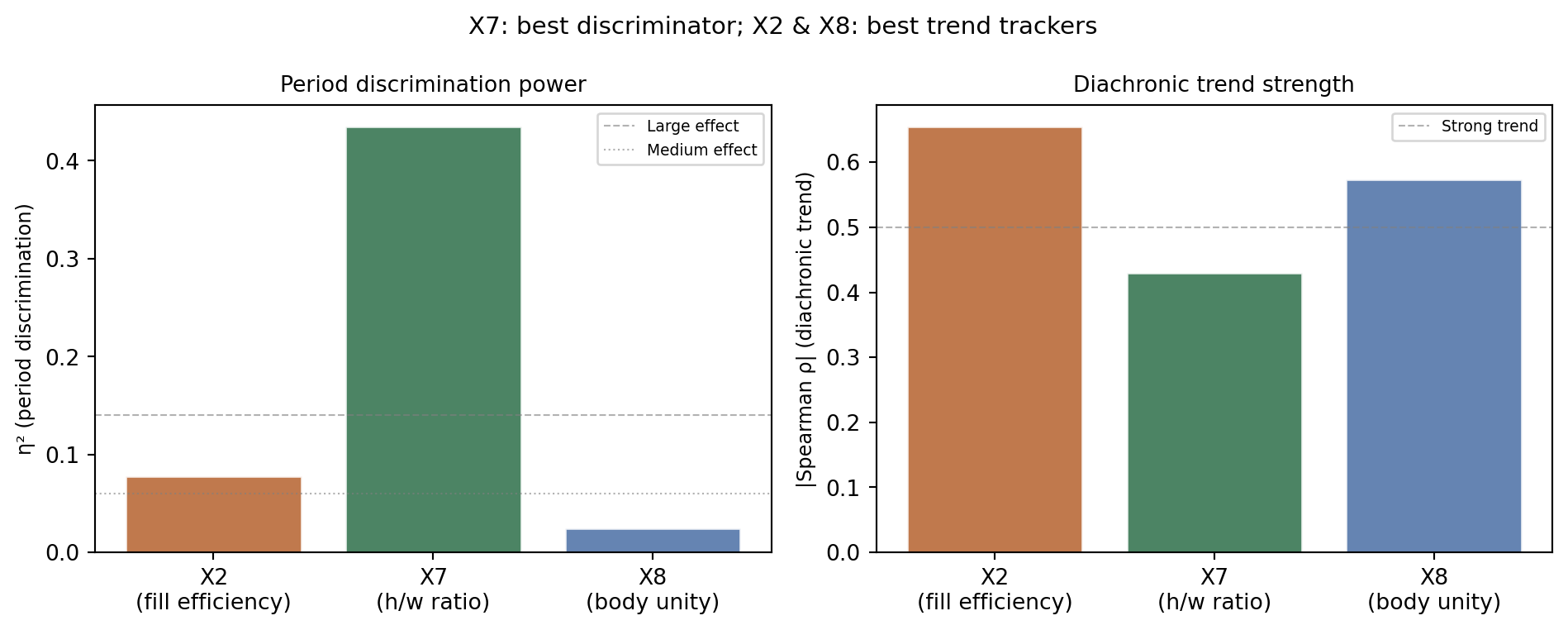
Figure 7: Three-panel summary: X7 discriminates traditions (η²=0.435) but shows no trend; X2 and X8 both trend across time (|ρ|>0.55) but discriminate less.
Dimension
η²
ρ
X7
0.435 (large)
0.430 (ns)
h/w ratio
Scribal tradition ID
X2
0.078 (medium)
0.655***
Fill efficiency
Diachronic tracking
X8
0.025 (small)
0.573**
Body unity
Secondary time signal
The discrimination vs. trend dissociation means that the dimension that best separates scribal traditions (X7) is not the dimension that best tracks time (X2), and vice versa. This is the latent-space analogue of distinguishing tradition from innovation: a scribal school can maintain its portrait orientation (high X7) while still moving toward more regularized outlines (increasing X2) over centuries.
Note
Next:Geographic Analysis → — whether the portrait-to-landscape shift is a Babylonian phenomenon or a pan-Mesopotamian one.
Source Code
---title: "5 · Shape Traversal"subtitle: "Physical meaning of the three key VAE dimensions"sidebar: analyses---> **Paper section:** Results §3.3–3.4 · **Notebooks:** `2.4`, `2.4b`, `10`, `11`, `13`## OverviewTo interpret what each VAE dimension physically encodes, we decode silhouettes at11 evenly-spaced points along each dimension axis, holding all others at theirperiod-genre mean. We then measure five geometric descriptors at each step:| Descriptor | Formula | Captures ||---|---|---|| h/w ratio | height ÷ width | overall orientation || Bounding-box fill | pixel area ÷ bounding-box area | how compactly the tablet fills its extent || Aspect ratio of fill | fill-adjusted h/w | shape after compactness correction || Contour complexity | perimeter² ÷ (4π × area) | outline irregularity (1 = circle) || Solidity | convex-hull area ÷ pixel area | body unity vs. articulated projection |For each traversal we identify the **primary descriptor** — the one that changes mostmonotonically. The primary descriptor is the physical meaning of that dimension.## X7 — diplomatic-tradition axis**Primary descriptor (all genres): h/w ratio**```{python}#| label: fig-x7-traversal#| fig-cap: "X7 traversal filmstrip: decoded silhouettes at 11 points along the X7 axis (Administrative baseline, Ur III mean). The silhouette transitions from tall portrait (left) to wide landscape (right). This is a pure orientation dimension."import matplotlib.pyplot as plt, matplotlib.image as mpimg, osfig_path ="../../paper/figures/fig_vae_traversal_X7_genre.pdf"if os.path.exists(fig_path):print(f"Traversal filmstrip: {fig_path}")print("This figure shows decoded silhouettes at 11 steps along the X7 axis,")print("stratified by genre (Administrative / Literary / Legal).")else:print("Figure not found. Run notebook 2.4b to generate.")```{#fig-x7-traversal}X7 controls **h/w ratio in isolation**: as X7 decreases from +4 to −4, the tabletsilhouette rotates smoothly from tall portrait to wide landscape, while its fillefficiency and outline complexity remain approximately constant. Critically, thisbehavior is **genre-consistent**: whether the baseline tablet is Administrative,Literary, or Legal, X7 traversal always produces the same portrait→landscape rotation.Genre-consistency makes X7 the cleanest single-number summary of scribal orientationtradition. A period's mean X7 value directly encodes whether its scribes worked in aportrait or landscape tradition, independent of genre composition.**Key period values:**| Period | Mean X7 | Tradition ||---|---|---|| Neo-Assyrian | +2.05 | Extreme portrait || Ur III | +0.89 | Portrait || Old Babylonian | +0.61 | Mild portrait || Neo-Babylonian | −1.14 | Landscape || Achaemenid | −2.48 | Strong landscape |## X2 — bounding-box fill efficiency (diachronic-drift axis)**Primary descriptor: fill efficiency (genre-inconsistent)**```{python}#| label: fig-x2-traversal#| fig-cap: "X2 traversal filmstrip: decoded silhouettes at 11 steps along the X2 axis, stratified by genre. Primary descriptor = bounding-box fill efficiency. Genre-inconsistency (descriptor changes across baselines) indicates X2 captures the interaction of orientation AND regularization."import matplotlib.pyplot as plt, osfig_path ="../../paper/figures/fig_vae_traversal_X2_genre.pdf"if os.path.exists(fig_path):print(f"Traversal filmstrip: {fig_path}")print("Administrative baseline: low X2 = articulated portrait, high X2 = compact landscape")print("Literary baseline: primary descriptor shifts — encodes genre-specific norms")else:print("Figure not found. Run notebook 2.4b to generate.")```{#fig-x2-traversal}X2 captures a **composite morphological feature**:- **Low X2** (Ur III admin mean = −0.995): tall portrait silhouette with an articulated, irregular outline — fingers, projections, and surface unevenness reduce fill efficiency- **High X2** (Achaemenid admin mean = +0.652): compact landscape rectangle with a smooth, regular outline — high fill efficiencyX2 tracks time better than X7 (Spearman ρ = +0.655 vs. −0.430) precisely because itcaptures **two simultaneous historical trends**:1. Portrait → landscape rotation (shared with X7)2. Outline regularization (additional signal not in X7)**Genre-inconsistency** (the primary descriptor shifts when you change the baselinegenre) is evidence that X2 encodes genre-specific shape norms layered on top of theglobal diachronic trend — not a methodological failure.## X8 — body unity / silhouette cohesion**Primary descriptor: solidity (genre-inconsistent for Admin vs. others)**```{python}#| label: fig-x8-traversal#| fig-cap: "X8 traversal filmstrip: decoded silhouettes at 11 steps along the X8 axis. Primary descriptor = solidity (convex-hull fill). High X8 = articulated/segmented; low X8 = unified slab."import matplotlib.pyplot as plt, osfig_path ="../../paper/figures/fig_vae_traversal_X8_genre.pdf"if os.path.exists(fig_path):print(f"Traversal filmstrip: {fig_path}")print("High X8: segmented outline with visible projections and divisions")print("Low X8: unified slab-like form, convex hull closely matches pixel area")else:print("Figure not found. Run notebook 2.4b to generate.")```{#fig-x8-traversal}X8 controls **silhouette cohesion**: whether the tablet body appears as a singleunified slab (low X8) or as an articulated form with projections and segments (high X8).This dimension tracks a separate historical trend — the progressive loss of the3rd-millennium rounded, organic tablet form in favor of the 1st-millennium regularized,brick-like form.Diachronic trend: Spearman ρ = −0.573 (p = 0.007), indicating X8 decreases (unifies)monotonically across time.## The discrimination vs. trend dissociationThe three dimensions reveal a structural finding:```{python}#| label: fig-x2x7x8-summary#| fig-cap: "Three-panel summary: X7 discriminates traditions (η²=0.435) but shows no trend; X2 and X8 both trend across time (|ρ|>0.55) but discriminate less."import pandas as pd, matplotlib.pyplot as plt, numpy as npdims = ['X2', 'X7', 'X8']eta2 = [0.078, 0.435, 0.025]abs_rho = [0.655, 0.430, 0.573]labels = ['X2\n(fill efficiency)', 'X7\n(h/w ratio)', 'X8\n(body unity)']colors = ['#b5622e', '#2c6e49', '#4a6fa5']fig, axes = plt.subplots(1, 2, figsize=(10, 4))# Left: eta2 comparisonaxes[0].bar(labels, eta2, color=colors, alpha=0.85, edgecolor='white')axes[0].set_ylabel('η² (period discrimination)', fontsize=9)axes[0].set_title('Period discrimination power', fontsize=10)axes[0].axhline(0.14, color='grey', ls='--', lw=0.8, alpha=0.6, label='Large effect')axes[0].axhline(0.06, color='grey', ls=':', lw=0.8, alpha=0.6, label='Medium effect')axes[0].legend(fontsize=7)# Right: |rho| comparisonaxes[1].bar(labels, abs_rho, color=colors, alpha=0.85, edgecolor='white')axes[1].set_ylabel('|Spearman ρ| (diachronic trend)', fontsize=9)axes[1].set_title('Diachronic trend strength', fontsize=10)axes[1].axhline(0.5, color='grey', ls='--', lw=0.8, alpha=0.6, label='Strong trend')axes[1].legend(fontsize=7)plt.suptitle('X7: best discriminator; X2 & X8: best trend trackers', fontsize=11)plt.tight_layout()plt.show()```| Dimension | η² | |ρ| | Physical meaning | Best use ||---|---|---|---|---|| **X7** | 0.435 (large) | 0.430 (ns) | h/w ratio | Scribal tradition ID || **X2** | 0.078 (medium) | 0.655*** | Fill efficiency | Diachronic tracking || **X8** | 0.025 (small) | 0.573** | Body unity | Secondary time signal |The **discrimination vs. trend dissociation** means that the dimension that bestseparates scribal traditions (X7) is not the dimension that best tracks time (X2),and vice versa. This is the latent-space analogue of distinguishing tradition frominnovation: a scribal school can maintain its portrait orientation (high X7) whilestill moving toward more regularized outlines (increasing X2) over centuries.::: {.callout-note}**Next:** [Geographic Analysis →](06-geography.qmd) — whether the portrait-to-landscapeshift is a Babylonian phenomenon or a pan-Mesopotamian one.:::